sown on stony ground is a space for me to explore biogeoengineering and the use of modelling to evaluate its climate change mitigation potential. Desert greening – past, present and future – is the principal theme, although it touches on wider issues in afforestation, land management and the carbon market.

Sunday, 28 February 2016

No coal is the goal

That Energy UK has decided to advocate for a shift from coal to green energy is news that could be celebrated by a student in the environmental sciences. Energy suppliers finally coming to terms with the destructive nature of their business and moving toward a break with fossil fuels? I should be keeping myself warm this Sunday by dancing around the house, a-whooping and a-hollering.

However, if you know me, or have been following this blog, then you may have observed that I can occasionally be given to some degree of cynicism. My gut instinct is to write off this sudden volte-face as little more than a ploy, a marketing stunt, a coldly calculated act of subterfuge. COP21 seemed to signal a change in climate change policy momentum. The world is supposed to be marching together toward a low-carbon future, and the energy industry can't be seen to be digging in its heels. For the sake of a greener image, coal — those ugly, dirty, heavily polluting bricks of fossilised vegetation — has to be forsaken. Fortunately, it makes for a handy sacrifice: the table below highlights its continual and rapid decline in importance as a source of energy, and in any case the government is minded to kill coal power altogether.

Coal has been supplanted by other fuel sources, primarily oil.
Total Energy Production in the UK, from a DECC press release.

A highly sceptical reader might therefore view this news not as some noble change of heart, but rather a simple acknowledgement of the inevitable — one that just happens to produce positive publicity.

As I said, that would be by instinctive reaction. However it's not always a good idea to blog directly from the gut; it can be valuable to take the time to ruminate on an issue. The article above states that Energy UK are championing a shift that's not just away from coal but also toward low carbon, so I wondered if this seemingly green attitude is borne out by the 125-page report which accompanied the announcement. Pathways to 2030 is a comprehensive document summarising the current attitudes and expectations of the British electricity sector, and it would be worth a read for those of you on courses with more of a focus on climate or energy policy.

If you have an anti-industry stance, then some the report's contents will not be unexpected. The first chapter makes the argument that the government should take more responsibility for conveying to the public the 'inevitable' increases in energy bills due to decarbonisation plans, reinforcing the narrative that tackling environmental concerns will hit people in the pocket. Personally I find this attitude rather disappointing, coming from an enormously profit-making industry — although I should admit here being among the 68% of the population who support their renationalisation. It's also unsuprising that the report takes aim at regulatory bodies OFGEM and DECC, for contributing to an "industry code process [that] has stifled innovation and is too bureaucratic for today’s needs". Given that I have little knowledge of the intricacies of governance structure, I'm unsure what to make of their suggestion for the creation of a new body: a 'systems architect', divorced from high level policy decisions, which is able to co-ordinate an energy sector framework integrated over multiple levels (see link in caption below). Is this a sensible push for more streamlined management, or an expression of the desire of companies for greater independence from regulatory interference?

Energy UK call for a reorganisation of the current energy system architecture, shown above, to increase flexibility and efficiency. (graphic from Institution of Engineering and Technology briefing paper)

There were, however, some points that came as a pleasant surprise. For example, I've only recently learned about how electricity providers struggle to cope with sudden spikes in demand, such as a million kettles coming on at half-time in the World Cup final. The Energy UK's proposal that this expensive volatility could be smoothed by greater interconnection of the power grid with Europe seems like a sound one. Similarly, they profess support for decentralised energy technologies, such as photovoltaics and battery storage. What I'm hoping this translates to is a commitment to increase investment in solar power and other renewables, despite their apparent abandonment by the UK government. This, combined with assertions such as "the power sector would (and should) continue to do most of the “heavy lifting” on decarbonisation", would indeed strike me as a clear positive step on behalf of the energy sector toward decarbonisation.

Though I need to spend more time gaining the expertise to properly digest this Pathways document, I am deciding to set my position on this news in the meanwhile to measured optimism. 

Thursday, 25 February 2016

Burgers can be made from beetroot?

If you work or study in the Euston area, you've probably walked past the Quaker Centre opposite Euston Station. As well as stocking an excellent selection books on spirituality, peace and sustainability, their Friends House restaurant is currently having a Meat Free March (which includes the tail end of February). I can vouch personally for the grub; I enjoy lunch there every week, and today I discovered that beetroot burgers are a) a thing, and b) delicious. If you consider yourself an environmentalist, or just want a hearty and wholesome meal, why not check it out this over the next month?


Thursday, 21 January 2016

"See the trees and the wood"

The common room in my Geography department is a little bit like a dentist's waiting area. However, instead of well-worn editions of Grazia and Trout Fisherman Magazine , you'll find lying around some slightly more academic — and considerably less read — publications, such as Scientific American and National Geographic. Today I was leafing through a copy of Nature when the phrase 'Treat forests as natural habitats' popped out at me. The line summarised a short correspondence from Bruun et al (2015) titled Forests: see the trees and the wood , a criticism of an earlier submission to the same journal for failing to recognise the natural value in forest ecosystems. This seemed right up my street, so I had to have a read of the article in question.

The comment piece (Fares et al, 2015), argues that European forest management policies should be reconsidered and centered more towards sustainability. At first, this doesn't seem at all seem unreasonable — I can't imagine many scientists supporting the practice of unsustainable forestry. However I think one has to question what exactly the authors really mean by 'sustainability'. In the hope that you get my point, I'll do my best to summarise the steps for managing Europe's forests that they suggest:
  • Plant stronger, more productive tree species that are more resilient to climate change.
  • Gear forest management strategies towards minimisation of disturbances (by removing dead or "excess" biomass to combat fires, and cultivation of more pest-resistant genetic lines) and maximisation of carbon storage (e.g.  more frequent harvests and greater practice of thinning).
  • Focus on quantifying and expanding forest's potential economic value: the use of tree biomass for renewable energy, as well the less tangible "ecosystem services" (such as their use for recreation and the protection offered to river catchments).
Notice a recurrent theme in this? Personally, I'm surprised by how commercially focused the notion of sustainability promoted in this article is. My expectation was that, given the threat posed by rapid anthropogenic climate change, it would have described various methods to protect forests and their biodiversity. It appears instead that Fares et al's argue for shaping European forestry policy so as to extract the maximum economic value from them, and the main criticism by Bruun et al. is that such strategies "overlook the implications for forests as natural ecosystems and run counter to biodiversity sustainability guidelines".


Fallen trees can provide a habitat for "a wealth of species that thrive on dead and decaying wood"( Bruun et al, 2015) . 
Is the economic valuation of forests, particularly for bioenergy production, necessarily at odds with protecting their wellbeing (from a conservationist perspective)? I don't know the answer, but it seems like it shouldn't be impossible to achieve both. At least I hope so, since this dilemma is central to the field of work I'm interested in. Then again, especially considering what I've learnt with regard to palm oil biodiesel , I probably shouldn't be too optimistic.

Friday, 8 January 2016

Creating energy from the earth

Plantations of the oil palm in Indonesia.
This isn't the first time I've mentioned  EURENSSA, nor will it be the last. Among the various presentations given at the environmental research camp, one of particular interest to me discussed the production of biodiesel from palm oil plantations in Indonesia. Today I had the opportunity to interview Noor Hossain, the Industrial Ecology student who delivered that presentation. I asked him to shed some light the topic of biofuel; his research in it, key issues involved, and how modellers can contribute. Have a listen to our discussion below, and if you're interested in Noor's research then you can check out his ResearchGate page here.


Tuesday, 5 January 2016

The silver bullet that twinkles green

I find that there's something incredibly brazen in naming a journal article Irrigated afforestation of the Sahara and the Australian Outback to end global warming. I think it's because, in my head, the word 'to' in the title reads as is going to, rather the likely intended sense of so as to. Ornstein, Aleinov & Rind's 2009 paper proposes a massive biogeoengineering scheme: the afforestation of currently desert land in order to sequester ~8 Pg C per year, enough to effectively halt anthropogenic climate change.
Ornstein et al suggest the use of Eucalyptus grandis, a fast growing species native to Australia that is commonly used in commercial forestry, such as this Kenyan timber plantation.


Initially, sea water desalination could supply the enormous irrigation necessary to support subtropical forests in an arid desert such as the Sahara. Eventually, however, the climatic feedback mechanisms that contributed to previous green Sahara states would come into effect (if you don't know about this then you clearly haven't been reading my blog), with the amplified monsoon rains sustaining these new plantations. Since forests tend towards CO2 neutrality as they mature, sections could be felled and replanted periodically, with the harvested trees being used for timber or to produce biofuel. Alternatively, this biomass could be pyrolysised to provide a renewable source of energy as well as produce biochar, a charcoal which can be buried to fertilise soil and store significant quantities of carbon in the ground.

To support these assertions, the study describes a GCM experiment in which the land surface of the Sahara and Australian Outback has been changed to represent a tropical forest, while soil moisture is artificially topped up at each time step so as to simulate irrigation.
Precipitation anomaly with an afforested Sahara and Outback. Image generated from supplementary video provided by authors.  
The resultant rainfall intensification shown above is very large, although it is not sufficient to completely supplant irrigation. Ornstein et al acknowledge that expense of this water supply, as well as those involved in the physical infrastructure necessary to establish a continent-spanning forest plantation, could be prohibitive. It is unlikely that the monetary value of the forest biomass (either as biofuel or more abstractly in the carbon trading market) would ever become economically competitive compared to fossil fuels, though even if this did happen it would still require a massive initial investment with a decades-long return period. With technological feasibility assumed, these costs, as well as the immense organisational difficulties involved, are identified by the authors as the most significant obstacles to such a desert afforestation scheme.
Like this, but in reverse. © John Holcroft
The Irrigated afforestation of the Sahara... paper provided the inspiration for this blog's name, so I'd really like to hear your opinions on the idea; whether from a modelling perspective and a more general one. Does the afforestation of the Sahara desert seem feasible to you? It amounts, essentially, to terraforming — are there any issues that you could see arising from this? If money wasn't an issue, would you support it?

Friday, 1 January 2016

The evolution of modelling

New year, new home.

Wait, that's not quite how it goes — not yet, anyway. Though humanity in 2016 is still stuck on the same planet that birthed it, our understanding of how the Earth works is improving year after year. In particular, the models that we use to emulate the climate system are becoming more and more powerful. The most advanced climate models are evolving to become Earth System Models, which are evolving in two main ways: increased resolution and more comprehensive incorporation of various physical processes.

To stress the importance of the former, have a listen to this short interview with Philip Rasch, the leader of the atmosphere group of the ACME project, a US government-funded collaborative effort to develop a next-generation ESM. While you listen, peruse this presentation on UKESM — the British answer to ACME — to gain an understanding of the challenges in the latter aspect of model complexity in ESMs. In particular, given that flexibility is very important if a model is to be usable for a wide array of applications, take note of the image on slide 18 (reproduced below) illustrating how modularity is incorporated into UKESM's design from the get go.

Organisation of the various components of UKESM
It's all exciting stuff, and I dream of being able to participate in the development of these kind of models someday (yes, my dreams are like this).

Thursday, 31 December 2015

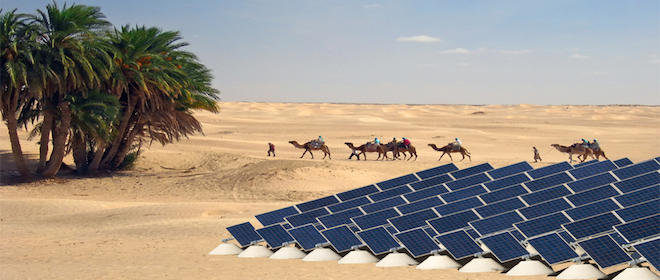
Should we solar panel the Sahara?

If you read newspapers often, it's likely you've come across Betteridge's law of headlines. Therefore, you wouldn't have to listen to this entire BBC World Service broadcast to find the answer to the question should we solar panel the Sahara? Still, you should do so anyway, or at least read the accompanying article.

The premise is simple. A back of the envelope calculation (page 2) finds that, combined, the world's deserts receive something on the order of 60 million terrawatt hours solar radiation per year — nearly 600 times the global energy consumption in 2012 (104426 TWh). If even a small fraction of this free and renewable source of energy could be harnessed by solar panels spread over the vast Saharan expanse, it could provide an important supply of power to Africa, Europe and the Middle East which doesn't contribute to global warming. This is what the renewable energy consortium Desertec are looking to achieve.
"Hey trees, stop hogging all the good sunlight"
Obviously there may be some technological issues in such a plan. To start with, as you might have noticed, the sun tends to hide at night. Temporal variability of power generation is one of the traditional issues with solar energy, and it's something I've personally experienced. At the EURENSSA conference I participated in this summer (I did say I'd bring this up again), it took a while for the solar geyser to get going, so I was shocked by the cold water the first time I went for a crack-of-dawn shower. However, advancements in thermal storage – in effect storing this energy by heating molten salt – provide a way for this power to be supplied as demand dictates.

The radio broadcast provides interesting discussion of the geopolitical implications of European companies buying African land in order to generate energy which will largely go back north. Similarly, the social and economic aspects of solar energy as a renewable resource are well covered. However, there is one thing that I'm left wondering, from a modelling perspective. The image below is taken from an EMIC experiment I carried out which simulated the plantation of forests in the Sahel region. It shows that the effects of this on global climate would be very drastic — the changes in pressure at mid/high latitudes are of a greater magnitude than the largest pressure drops recorded in hurricanes. By lowering the albedo of the Sahel's grid cells (to simulate the land's change from savannah to forest), the area became a stronger source of both latent and sensible heat, resulting in a cascade of changes to the atmospheric circulation system.

The pressure anomaly between a control simulation and a green Sahel experiment 
 It should be noted that the limited complexity of the atmosphere model used means that any conclusions drawn from these results should be taken with a very conservative pinch of salt. Nevertheless, this experiment showed me the importance of considering the possible effect of any change in one region on other parts of the world, and such large-scale atmospheric teleconnections are being increasingly found by modelling experiments. One study found that during the transition out of the African Humid Period, attenuation of meridional heat transport was initiated by the aridification (therefore albedo increase) of the Sahara, leading to a strong cooling over the Arctic; while another found a similar mechanism occurring with 65 Ma boundary conditions. Solar panels are dark in colour to absorb as much radiation as possible, however they do re-emit much of this energy. If you consider the construction of huge solar arrays in the Sahara as analogous to afforestation in terms of change in albedo, you should be able to see why modelling should not be neglected when assessing the possible implications of such an ambitious scheme.