sown on stony ground is a space for me to explore biogeoengineering and the use of modelling to evaluate its climate change mitigation potential. Desert greening – past, present and future – is the principal theme, although it touches on wider issues in afforestation, land management and the carbon market.
Late last night I returned to London from a family wedding reception in Nottingham. Though time was too short to make a trip out to Sherwood Forest, I did get some immersion the Robin Hood mythology at Nottingham Castle's museum. During one video exhibition, a nature reserve manager spoke on Sherwood's history, noting that the region was traditionally the site of a great deal of human activity. A rich picture was painted of a busy woodland during the middle ages, a site of royal hunts and diverse industries scattered with outlaw settlements and rowdy parties. This description came as a considerable surprise to me, running contrary to my preconception of such areas as wild preserves remote from human activity. It's quite clear that I haven't got enough experience of British forests.
Looks fun, but how did they power the sound system?
Apparently, I'm not the only one. The forester in the video lamented that Sherwood, like many forests across the country, is now sorely under-utilised by the general public. He urged people to make more use of these natural resources, considering the lush backdrop they offer for excitement, exploration and adventure as much as for rest and peaceful reflection. There's little point in me speculating on why woodland recreation is not as popular as it once was — it would be lazy just to blame TV and the internet. What I can do is make a personal commitment to enjoy as much of the great outdoors as I can, while I can. I'm fortunate enough to live within walking distance of Footscray Meadows (or Five Arches, the stomping ground of my youth), Joyden's Wood and Scadbury Park nature reserve, so I always have a place to unwind during the working week; while this summer I'll be free to venture further afield and really experience what the UK's woodlands have to offer.
*
I'm guessing that most of my readers are in my university department, and I think Geographer's would generally be described as "outdoorsy". Does this stereotype hold true for you? Do you have any interesting forest tales, or recommendations to visit?
Yesterday a Mrs Cathy Smith, general manager at Cisco South Africa and dear Aunty of mine, shared with me an article describing the 'digitisation of energy', a concept which I interpret to characterise the digital monitoring of power use, from production through to consumption. Collecting, collating and analysing these data would, it argues, allow energy companies to minimise wastage and greatly increase the efficiency — and cost effectiveness — of their power delivery. Data analytics is a tool which has shown considerable success at optimising processes in manufacturing, and its implementation on a industry-wide scale strikes me as a great way for the energy sector to make overtures to the carbon neutrality the world so desperately needs if we are to avoid the worst of climate change.
That said, I have some reservations when it comes to anything that falls under the umbrella of "big data", the main one being the (digital) age-old issue of access. The production of large, fruitful datasets is likely to entail a considerable investment on the part of energy companies, and so I can't imagine that they would feel any great inclination to share these data without compensation. The adoption of such a position would be a shame, especially to those involved in academia; as a student I personally have relied heavily on the privilege of free use of the diverse geographical datasets made available by governmental bodies such as the USGS and Ordnance Survey. Who knows what kinds of innovative research — both institutional and crowdsourced — that could be achieved if inquisitive minds are allowed to access the wealth of information resulting from the digitisation of energy? A commitment to the concept of open data need not merely be a lofty ideal, but a principle which has been repeatedly demonstrated to be economically beneficial.
Even more important than the sharing of data outside of an industry is sharing within it. Consider my post several weeks ago in which I discussed the views of the British energy lobby. One point that stood out for me was their proposal to restructure the UK sector's regulatory system by introducing a 'systems architect': a body which would be better suited to coordinating an efficient power supply network as it takes on an increasingly decentralised structure. For such a system to be effective must require a great degree of co-operation is required between its various components — from power station operators to government regulators to local consumer-side organisations and everything in-between. It seems to me that the only way to achieve such frictionless collaboration is the removal of barriers to access to information. Greater integration of the power supply chain with outside parties would come as a bonus, with benefits both commercial and intangible. With energy being rapidly digitised, I believe that the resultant data must be made open if the industry is to make serious reductions in greenhouse gas emissions.
It's rare that I meet somebody who actively opposes tackling deforestation, pollution, or reducing our dependency on fossil fuel. I notice that young people tend to be particularly aware of such issues, and Ipsos Mori's latest Issues facing Britain today survey finds highest concern for the environment amongst the 18-24 group, to which I just about belong. Nevertheless, with only 2% of Britons considering it to be the most important issue, it's clear that the environment is not at the forefront of most people's minds. This would probably come as less of a surprise to me if I spent more time socialising outside the Geography bubble. Economy, on the other hand, has always ranked at or near the top of these polls over the last decade. Talking to students outside of my department, a recurrent idea put forward is that tackling environmental issues is admirable pursuit but, ultimately, an economically costly one. For many, being green is a luxury that the UK can't really afford right now.
Can nature boost a county's economy? is an interesting piece from the BBC which shows how nations can harness their "natural resources"*, with a focus on renewable energy production. This runs counter the narrative described above, as you can see from this extract of a discussion with a UCL professor:
"What we have to get away from is thinking that somehow environment is opposed to economic activity, and [instead] recognise that environment contributes enormously to human life, and find ways of integrating those things in our minds.
Check out the article, have a listen to the associated radio broadcast, and let me know what you think of the idea that caring for the environment comes at a financial cost.
*I've put this term in scare quotes because I find it to be a rather jarring concept. This is is a feeling that I'm not quite equipped to expound right now, but I promise to get back to it in later posts.
That Energy UK has decided to advocate for a shift from coal to green energy is news that could be celebrated by a student in the environmental sciences. Energy suppliers finally coming to terms with the destructive nature of their business and moving toward a break with fossil fuels? I should be keeping myself warm this Sunday by dancing around the house, a-whooping and a-hollering.
However, if you know me, or have been following this blog, then you may have observed that I can occasionally be given to some degree of cynicism. My gut instinct is to write off this sudden volte-face as little more than a ploy, a marketing stunt, a coldly calculated act of subterfuge. COP21 seemed to signal a change in climate change policy momentum. The world is supposed to be marching together toward a low-carbon future, and the energy industry can't be seen to be digging in its heels. For the sake of a greener image, coal — those ugly, dirty, heavily polluting bricks of fossilised vegetation — has to be forsaken. Fortunately, it makes for a handy sacrifice: the table below highlights its continual and rapid decline in importance as a source of energy, and in any case the government is minded to kill coal power altogether.
Coal has been supplanted by other fuel sources, primarily oil.
Total Energy Production in the UK, from a DECC press release.
A highly sceptical reader might therefore view this news not as some noble change of heart, but rather a simple acknowledgement of the inevitable — one that just happens to produce positive publicity.
As I said, that would be by instinctive reaction. However it's not always a good idea to blog directly from the gut; it can be valuable to take the time to ruminate on an issue. The article above states that Energy UK are championing a shift that's not just away from coal but also toward low carbon, so I wondered if this seemingly green attitude is borne out by the 125-page report which accompanied the announcement. Pathways to 2030is a comprehensive document summarising the current attitudes and expectations of the British electricity sector, and it would be worth a read for those of you on courses with more of a focus on climate or energy policy.
If you have an anti-industry stance, then some the report's contents will not be unexpected. The first chapter makes the argument that the government should take more responsibility for conveying to the public the 'inevitable' increases in energy bills due to decarbonisation plans, reinforcing the narrative that tackling environmental concerns will hit people in the pocket. Personally I find this attitude rather disappointing, coming from an enormously profit-making industry — although I should admit here being among the 68% of the population who support their renationalisation. It's also unsuprising that the report takes aim at regulatory bodies OFGEM and DECC, for contributing to an "industry code process [that] has stifled innovation and is too bureaucratic for today’s needs". Given that I have little knowledge of the intricacies of governance structure, I'm unsure what to make of their suggestion for the creation of a new body: a 'systems architect', divorced from high level policy decisions, which is able to co-ordinate an energy sector framework integrated over multiple levels (see link in caption below). Is this a sensible push for more streamlined management, or an expression of the desire of companies for greater independence from regulatory interference?
There were, however, some points that came as a pleasant surprise. For example, I've only recently learned about how electricity providers struggle to cope with sudden spikes in demand, such as a million kettles coming on at half-time in the World Cup final. The Energy UK's proposal that this expensive volatility could be smoothed by greater interconnection of the power grid with Europe seems like a sound one. Similarly, they profess support for decentralised energy technologies, such as photovoltaics and battery storage. What I'm hoping this translates to is a commitment to increase investment in solar power and other renewables, despite their apparent abandonment by the UK government. This, combined with assertions such as "the power sector would (and should) continue to do most of the “heavy lifting” on decarbonisation", would indeed strike me as a clear positive step on behalf of the energy sector toward decarbonisation.
Though I need to spend more time gaining the expertise to properly digest this Pathways document, I am deciding to set my position on this news in the meanwhile to measured optimism.
If you work or study in the Euston area, you've probably walked past the Quaker Centre opposite Euston Station. As well as stocking an excellent selection books on spirituality, peace and sustainability, their Friends House restaurant is currently having a Meat Free March (which includes the tail end of February). I can vouch personally for the grub; I enjoy lunch there every week, and today I discovered that beetroot burgers are a) a thing, and b) delicious. If you consider yourself an environmentalist, or just want a hearty and wholesome meal, why not check it out this over the next month?
The common room in my Geography department is a little bit like a dentist's waiting area. However, instead of well-worn editions of Grazia and Trout Fisherman Magazine , you'll find lying around some slightly more academic — and considerably less read — publications, such as Scientific American and National Geographic. Today I was leafing through a copy of Nature when the phrase 'Treat forests as natural habitats' popped out at me. The line summarised a short correspondence from Bruun et al (2015) titled Forests: see the trees and the wood, a criticism of an earlier submission to the same journal for failing to recognise the natural value in forest ecosystems. This seemed right up my street, so I had to have a read of the article in question.
The comment piece (Fares et al, 2015), argues that European forest management policies should be reconsidered and centered more towards sustainability. At first, this doesn't seem at all seem unreasonable — I can't imagine many scientists supporting the practice of unsustainable forestry. However I think one has to question what exactly the authors really mean by 'sustainability'. In the hope that you get my point, I'll do my best to summarise the steps for managing Europe's forests that they suggest:
Plant stronger, more productive tree species that are more resilient to climate change.
Gear forest management strategies towards minimisation of disturbances (by removing dead or "excess" biomass to combat fires, and cultivation of more pest-resistant genetic lines) and maximisation of carbon storage (e.g. more frequent harvests and greater practice of thinning).
Focus on quantifying and expanding forest's potential economic value: the use of tree biomass for renewable energy, as well the less tangible "ecosystem services" (such as their use for recreation and the protection offered to river catchments).
Notice a recurrent theme in this? Personally, I'm surprised by how commercially focused the notion of sustainability promoted in this article is. My expectation was that, given the threat posed by rapid anthropogenic climate change, it would have described various methods to protect forests and their biodiversity. It appears instead that Fares et al's argue for shaping European forestry policy so as to extract the maximum economic value from them, and the main criticism by Bruun et al. is that such strategies "overlook the implications for forests as natural ecosystems and run counter to biodiversity sustainability guidelines".
Fallen trees can provide a habitat for "a wealth of species that thrive on dead and decaying wood"( Bruun et al, 2015) .
Is the economic valuation of forests, particularly for bioenergy production, necessarily at odds with protecting their wellbeing (from a conservationist perspective)? I don't know the answer, but it seems like it shouldn't be impossible to achieve both. At least I hope so, since this dilemma is central to the field of work I'm interested in. Then again, especially considering what I've learnt with regard to palm oil biodiesel , I probably shouldn't be too optimistic.
This isn't the first time I've mentioned EURENSSA, nor will it be the last. Among the various presentations given at the environmental research camp, one of particular interest to me discussed the production of biodiesel from palm oil plantations in Indonesia. Today I had the opportunity to interview Noor Hossain, the Industrial Ecology student who delivered that presentation. I asked him to shed some light the topic of biofuel; his research in it, key issues involved, and how modellers can contribute. Have a listen to our discussion below, and if you're interested in Noor's research then you can check out his ResearchGate page here.
I find that there's something incredibly brazen in naming a journal article Irrigated afforestation of the Sahara and the Australian Outback to end global warming. I think it's because, in my head, the word 'to' in the title reads as is going to, rather the likely intended sense of so as to. Ornstein, Aleinov & Rind's 2009 paper proposes a massive biogeoengineering scheme: the afforestation of currently desert land in order to sequester ~8 Pg C per year, enough to effectively halt anthropogenic climate change.
Ornstein et al suggest the use of Eucalyptus grandis, a fast growing species native to Australia that is commonly used in commercial forestry, such as this Kenyan timber plantation.
Initially, sea water desalination could supply the enormous irrigation necessary to support subtropical forests in an arid desert such as the Sahara. Eventually, however, the climatic feedback mechanisms that contributed to previous green Sahara states would come into effect (if you don't know about this then you clearly haven't been readingmyblog), with the amplified monsoon rains sustaining these new plantations. Since forests tend towards CO2 neutrality as they mature, sections could be felled and replanted periodically, with the harvested trees being used for timber or to produce biofuel. Alternatively, this biomass could be pyrolysised to provide a renewable source of energy as well as produce biochar, a charcoal which can be buried to fertilise soil and store significant quantities of carbon in the ground.
To support these assertions, the study describes a GCM experiment in which the land surface of the Sahara and Australian Outback has been changed to represent a tropical forest, while soil moisture is artificially topped up at each time step so as to simulate irrigation.
The resultant rainfall intensification shown above is very large, although it is not sufficient to completely supplant irrigation. Ornstein et al acknowledge that expense of this water supply, as well as those involved in the physical infrastructure necessary to establish a continent-spanning forest plantation, could be prohibitive. It is unlikely that the monetary value of the forest biomass (either as biofuel or more abstractly in the carbon trading market) would ever become economically competitive compared to fossil fuels, though even if this did happen it would still require a massive initial investment with a decades-long return period. With technological feasibility assumed, these costs, as well as the immense organisational difficulties involved, are identified by the authors as the most significant obstacles to such a desert afforestation scheme.
The Irrigated afforestation of the Sahara... paperprovided the inspiration for this blog's name, so I'd really like to hear your opinions on the idea; whether from a modelling perspective and a more general one. Does the afforestation of the Sahara desert seem feasible to you? It amounts, essentially, to terraforming — are there any issues that you could see arising from this? If money wasn't an issue, would you support it?
Wait, that's not quite how it goes — not yet, anyway. Though humanity in 2016 is still stuck on the same planet that birthed it, our understanding of how the Earth works is improving year after year. In particular, the models that we use to emulate the climate system are becoming more and more powerful. The most advanced climate models are evolving to become Earth System Models, which are evolving in two main ways: increased resolution and more comprehensive incorporation of various physical processes.
To stress the importance of the former, have a listen to this short interview with Philip Rasch, the leader of the atmosphere group of the ACME project, a US government-funded collaborative effort to develop a next-generation ESM. While you listen, peruse this presentation on UKESM — the British answer to ACME — to gain an understanding of the challenges in the latter aspect of model complexity in ESMs. In particular, given that flexibility is very important if a model is to be usable for a wide array of applications, take note of the image on slide 18 (reproduced below) illustrating how modularity is incorporated into UKESM's designfrom the get go.
Organisation of the various components of UKESM
It's all exciting stuff, and I dream of being able to participate in the development of these kind of models someday (yes, my dreams are like this).
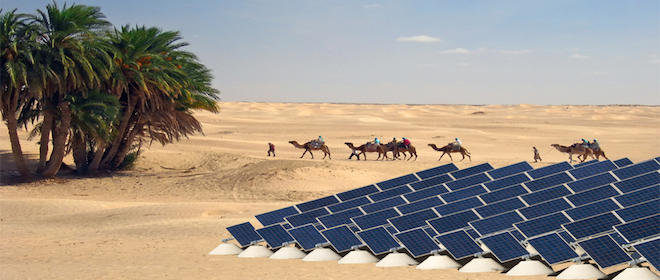
The premise is simple. A back of the envelope calculation (page 2) finds that, combined, the world's deserts receive something on the order of 60 million terrawatt hours solar radiation per year — nearly 600 times the global energy consumption in 2012 (104426 TWh). If even a small fraction of this free and renewable source of energy could be harnessed by solar panels spread over the vast Saharan expanse, it could provide an important supply of power to Africa, Europe and the Middle East which doesn't contribute to global warming. This is what the renewable energy consortium Desertec are looking to achieve.
"Hey trees, stop hogging all the good sunlight"
Obviously there may be some technological issues in such a plan. To start with, as you might have noticed, the sun tends to hide at night. Temporal variability of power generation is one of the traditional issues with solar energy, and it's something I've personally experienced. At the EURENSSA conference I participated in this summer (I did say I'd bring this up again), it took a while for the solar geyser to get going, so I was shocked by the cold water the first time I went for a crack-of-dawn shower. However, advancements in thermal storage – in effect storing this energy by heating molten salt – provide a way for this power to be supplied as demand dictates.
The radio broadcast provides interesting discussion of the geopolitical implications of European companies buying African land in order to generate energy which will largely go back north. Similarly, the social and economic aspects of solar energy as a renewable resource are well covered. However, there is one thing that I'm left wondering, from a modelling perspective. The image below is taken from an EMIC experiment I carried out which simulated the plantation of forests in the Sahel region. It shows that the effects of this on global climate would be very drastic — the changes in pressure at mid/high latitudes are of a greater magnitude than the largest pressure drops recorded in hurricanes. By lowering the albedo of the Sahel's grid cells (to simulate the land's change from savannah to forest), the area became a stronger source of both latent and sensible heat, resulting in a cascade of changes to the atmospheric circulation system.
The pressure anomaly between a control simulation and a green Sahel experiment
It should be noted that the limited complexity of the atmosphere model used means that any conclusions drawn from these results should be taken with a very conservative pinch of salt. Nevertheless, this experiment showed me the importance of considering the possible effect of any change in one region on other parts of the world, and such large-scale atmospheric teleconnections are being increasingly found by modelling experiments. One study found that during the transition out of the African Humid Period, attenuation of meridional heat transport was initiated by the aridification (therefore albedo increase) of the Sahara, leading to a strong cooling over the Arctic; while another found a similar mechanism occurring with 65 Ma boundary conditions. Solar panels are dark in colour to absorb as much radiation as possible, however they do re-emit much of this energy. If you consider the construction of huge solar arrays in the Sahara as analogous to afforestation in terms of change in albedo, you should be able to see why modelling should not be neglected when assessing the possible implications of such an ambitious scheme.
Today I learned that I'm a Millenial. My fellow Millenial Finn Harries argues that we Millennials must keep up the pressure following the Paris climate deal. Are you a Millenial? I hope this article inspires you take action. The future of the world is in Millenial hands, as it is our "responsibility to find practical solutions to the environmental problems we have inherited". Arise, Millenials, arise!
Please excuse the sardony, it's getting late, and I didn't get the game I wanted for Christmas. I'll be sincere for a moment, because this article did get me thinking about the way older generations might think differently about COP21. This is particularly topical, given that the winter holiday period is considered a time for friends and family to come together. Let me know; in your conversations with those closest to you, do you ever discuss environmentalism? If so, do you see any difference in the attitudes between your contemporaries and your elders with regard to issues such as climate change, land use, and biodiversity?
Kindly follow the link below to watch Christiane Amanpour interview the head of the U.N. Framework Convention on Climate Change, Christiana Figueres, who was yesterday recognised as one of Nature's Ten people who mattered in science this year, on the achievements of COP21.
Something that jumped out at me is part of the interviewee's response to the criticism that the emissions reductions pledges made at the conference do not seem to be enough to meet a 2 °C target (~ 04:45).
"We do have major technologies that are only beginning to step into their potential and what this calls is forward is to actually exploit the full potential of [renewables], and of course there are other technologies that are coming on board and that I think are going to be accelerated by this huge push . . . This is not something that is going to be solved at the stroke of a pen, or even at the gavelling of a legal document . . . What has to happen now is that [evolutions in capital, technology and policy] can and will be accelerated through this global agreement."
Count how many times the words 'capital' and 'technology' are repeated over the course of this interview. It appears to me that Ms Figueres wants to stress that the UN's climate change strategy is not so much one of curbing emissions, but reliance instead on business to invest in mitigation technologies – an attitude that makes me rather uneasy.
Also, for some reason, I also find the use of the word 'exploit' in this quote very, very droll.
Over at The Global Hot Potato, Chloe has been posting a bunch of environmentally friendly recipes, all in the spirit of COP21. They've been making me hungry as they pop up on my blogfeed, and I particularly want to try my hand at putting a Durban twist (read: add chilli powder) on the beefless stroganoff. Not too long ago I would have scoffed at the idea of voluntarily omitting meat from a dish, and I think most of my generation would have done the same. Over the last few years, however, many of my friends have begun following vegan or vegetarian diets, and for various different reasons. For some, the suffering of animals in the meat industry is too much to bear. Some are unable to support the cruel practices they observe in industrial agriculture, while one friend believes it's simply unethical to take the life of another creature for personal benefit. For others, it's not so much an animal welfare issue as one of health - physical, mental and spiritual. However, the most frequent case I've heard from proponents of the veg-lifestyle is an environmental one.
I promise you that I have no real intention to sell you anything, to influence what you put on your plate this evening. However, for the sake of argument, I will do my best imitation, from the perspective of a science-minded environmentalist. It shouldn't be difficult; I think we can all acknowledge that the production of meat for food is particularly unkind to the environment. This study developed a simulation model of a cattle farming system to assess its efficiency, finding it takes 6 – 9 times more feed to produce an equivalent quantity of North-American Hereford beef. Meat is not just energy intensive product, it's also a messy one. At the moment, nearly 20% of global greenhouse gas emissions are from pastoral agriculture, and this is a figure that can only grow as meat consumption rapidly increases across the developing world. Modelling has been used to increase our understanding of the historical impact of agriculture on the climate change, and how that will change in the future as the farmed surface area grows. It doesn't look like it will be a positive one, and it's clear that we all need to reduce our meat intake.
Contributions to the greenhouse gas emissions of pastoral farming, reproduced from McMichael et al (2007). People always tell me it's mostly cow's farting and burping, but it turns to be a load of bull plop.
I was trying to be careful in my wording earlier in the first paragraph: I specifically didn't say 'have become vegan or vegetarian', as diet is not always a strong part of a person's identity. Consider the reverse: consumption of meat does not necessarily a badge-wearing Meat Eater make. That said, for many, what you put into your stomach is indeed a core component of self-image, and there are two social groups in whom I've noticed this most strongly. The parkour community (if you don't know then I insist you watch) is the first of these. For many of parkour's most ardent enthusiasts the body is a temple, and veganism its central religion.The second is a group that is more loosely defined: environmentalists. Among my fellow Geography undergraduates at Bristol, it wasn't particularly uncommon to find people who claimed to care about the environment. However I think my first encounter with environmentalists of the more dedicated breed was at the student environmental research camp EURENSSA, hosted this summer on a permaculture farm bordering the Saxon Switzerland National Park. I could (and probably will) dedicate some serious blog-inches to talking about this amazing experience, but for now I'll let you watch this to get some sense of the vibe*:
At EURENSSA 2015, on order from it's student organisers, meat was off the menu from day one. For me it was a pleasant surprise. It had probably been years since I'd gone a day without eating flesh, and I regularly eat a carton of eggs in one sitting, but it did feel good in a way I can't really explain. I wasn't alone in the lack of complaint; the majority of its participants, students in the environmental sciences, were keen environmentalists for whom veganism is a central tenet of their approach to life.
Clearly then, some consider it very important to eat green. Given what you're studying, and what I'm sure you know about the environmental impact of raising livestock, do you think it's possible to reconcile meat consumption with environmentalism? Does one have to be vegan or vegetarian to be able to call themselves an environmentalist? Do you even consider yourself to be an environmentalist? Let me know in the comment section below.
* I'm secretly hoping you clicked through randomly, and so didn't see any fish.
As I discussed in an earlier post, climate modelling studies have generally been unable to simulate the magnitudeof greening indicated by proxy evidence. Up until now, it has served my narrative nicely to treat the palaeodata as if they were gospel. By ignoring the possibility of any uncertainty in observations, it follows logically that any model-data disagreement is due to error in the model. If your experiments results aren't pretty then they must be wrong, right?
It should be pretty obvious that this isn't true.
The cool tropics paradox is a a textbook example of the dangers of having too much faith in palaeodata. During the greenhouse of the late Cretaceous (~66 Ma), conditions at the poles were positively balmy, warm enough for crocodiles to thrive. However, the sea-surface temperature signal recorded in benthic foraminifera fossils (δ18O) appeared to indicated that tropics were cooler than they are today. As illustrated in the plot below, climate models were unable to reproduce this relatively flat latitudinal temperature gradient.
Model temperatures indicated by dotted line, palaeodata temperatures by solid line. Reproduced from Poulsen et al. (1999).
In fact, for GCMs to simulate the conditions indicated by the proxy temperature signal would have required an overhaul of the understanding of the physics governing poleward heat transport. Thankfully, it turned out that much of the model-proxy disagreement was due to error in the palaeodata — poor preservation of the foram fossils altered the δ18O signal to produce unrealistically low temperatures at low latitudes. This later inspired the development of more robust proxy archives such as TEX86 and Mg/Ca, which provided further support of models.
I'm discussing the cool tropics paradox to illustrate why, when comparing models and data, it is important to validate each with the other. While it is expected for modellers to be critical of their experiment results, it is key to remember that observations, too, cannot always be trusted. I will be exploring an example that is more relevant Green Sahara example in my next post.
Global policy on the future of the Earth's climate might be decided this week, if we're lucky enough. World leaders, policy-makers, journalists and observers all descended this morning on Le Bourget, a banlieue of Paris, to participate in the 21st UN Climate Conference with a stated objective to achieve:
a legally binding and universal agreement on climate, with the aim of keeping global warming below 2°C.
Hopes are high that this conference will be The One. Ed Milliband wrote that COP21 "can save the planet" and today Barack Obama recognised it as a "turning point". If you take even a casual interest in environmental issues, then I don't I need to explain why it is so important that the global community come to a firm consensus on how to best steer our planet away from dangerous climate change.
The bulk of today's session involved world leaders presenting to the world their positions, objectives and commitments with regards to climate change. While there were was no shortage of rousing and impassioned speeches, it is the start of the Lima–Paris Action Agenda Focus on Forests session tomorrow which is of particular interest to me personally, given the topic of this blog. At last year's conference in Peru, fourteen highly-forested developing countries issued a challenge to developed nations to kindle and develop financial partnerships in order to meet emission reduction targets with the use of forest carbon. In essence, the Lima Challenge is a call for greater recognition — and therefore, possibly, exploitation — of the economic value locked up in billions of carbon-stocking trees. Something in me questions the wisdom of this kind of thinking — see this article for an excellent case study of the limited success of REDD+ in Papua New Guinea.
Questionable effectiveness is not my only opposition to such schemes: that Earth's great expanses of green forest can be reduced to their mere economic value is an idea which is morally troubling to me (this might seem funny, if you like, considering I'm studying Environmental Modelling). However, I recognise that this may seem like a rather cynical way of looking at things, and I'd be interested to hear your general opinions on forestry-based carbon trading initiatives. As developing countries increasingly push for the economic valuation of their forests as a marketable resource, how much importance do you think should be placed on biodiversity, or any intangible value inherent to forest life? The session tomorrow morning will be introduced by Prince Charles; Ségolène Royale, the French Minister of Ecology, Sustainable Development and Energy; and Manuel Pulgar-Vidal, the Peruvian Minister of Environment. As they set the tone for the day's discourse, I hope that, among all the talk of business commitments, emission reduction partnerships and low-carbon development strategies, somebody will find the time to see the forest for more than just the cash growing on its trees.
In my most recent post I outlined how atmosphere circulation models were used to develop a mechanistic understanding of how the climate system is able to would be able to produce a green Sahara in the mid-Holocene. However, there are several important issues with these modelling experiments that need to be discussed.
As this image shows, the low spatial resolutions of these early models mean that one grid cell represents a large area of the continent. When combined with relatively sparse spatial coverage of the observation sites, the difficulty in the evaluating the extent of monsoon penetration into the Sahara with any great degree of precision is apparent. More detailed palaeoclimatic maps were developed over the course of time, against which models of increasing resolution could be assessed. These datasets proved key to the first phase of the Paleoclimate Model Intercomparison Project (PMIP); a collection of experiments established in the 1990s in order to evaluate the ability of eighteen different AGCMs to reproduce African Humid Period state when run with 6 ka parameters and boundary conditions. The project found considerable agreement in results between the different experiments, but that "the magnitude of the monsoon increases over northern Africa are underestimated by all the models". This reveals one of the most significant weaknesses of such complex models: the comprehensive inclusion of complex processes is restrained by the available processing power of the computers they run on. AGCMs — as the term implies — simulate atmosphere dynamics only. Other constituents of the Earth system, such as the ocean or the ice sheets, must be either prescribed or omitted.
Following the somewhat dissatisfying results of PMIP Phase 1, however, the palaeoclimate modelling community took advantage of ever-increasing computational resources to run more complex experiments, and at higher resolutions, to more success. For example, one experiment found that, when the land surface scheme is prescribed to be more representative of a vegetated Sahara, the 6 ka WAM reaches further northward and is considerably enhanced. This implies that the simulation of land surface–atmosphere feedbacks would be important in getting a more realistic monsoon, and indeed that assertion was supported by the improved results of models which included interactive soil moisture, snow or vegetation components. Nevertheless, it became apparent that the realism of these experiments was to a degree limited by the fact that they simulated atmosphere circulation only, as it was likely that the ocean also had a part to play in intensifying the mid-Holocene monsoon.
6 ka WAM precipitation reachers further northwards with a full AOGCM (dashed line) than with prescribed SSTs (dotted line). Solid line is control experiment. Reproduced from Braconnot et al (2000).
In a general sense, incorporating more components in a modelled experiment allows a wider range of climate processes to be simulated, and interact with each other, producing a stronger monsoon. However, similarly complex models can vary widely in their results, as shown in the image below reproduced from a study comparing two AOVGCMs whose atmosphere core differs.
6 ka precipitation anomaly from ECHAM and LMD models, initialised with present day (left) and green Sahara (right) vegetation. It is clear that there is much greater monsoon penetration using ECHAM.
The key takeaway from this is that the degree to which the mid-Holocene WAM is intensified by inclusion of vegetation is strongly dependent on any given model's treatment of atmospheric circulation dynamics. The same conclusion emerged at the conclusion of the second phase of the PMIP, which also found that model results vary not only in their response to mid-Holocene forcing, but also to modern forcing.
"Model biases or differences between the control experiments
need to be considered to understand the response of various
models"
Since much of the variation in the results the model experiments discussed here is due to uncertainty in their parameterisation of real life physics (as observed today), it is very difficult to assess how representative the modelled mechanisms are of the true climatic processes that generated the green Sahara.
None of the PMIP Phase 2 studies successfully reproduced the observed AHP conditions. It appears that thus far, even with the inclusion of oceans, vegetation, and soil, there is something in climate models which makes them too restrained in their simulations of the mid-Holocene monsoon. I'm not yet sure why. It is possible that there is some conservative bias inherent to the operation of all GCMs. Alternatively, there may still be some monsoon-intensifying mechanisms which are as-yet unknown or otherwise incompletely modelled. The next PMIP phase will involve the use of ESMs, a class of model which incorporate a far more comprehensive range of Earth System components, and therefore climatic processes, than previous generations of models.
It is worth pointing out that Moore's law may not hold much longer. I don't say this to imply that climate models will be approaching some kind of peak complexity any time soon, but rather because it's relevant to my doubts about a particular line of thinking in modelling. I'm not sure whether the best way to tackle model–data disagreement over the green Sahara is simply to chuck more computing power at the problem. That said, I don't yet have any truly valid reason to be sceptical. Either way, I think it's worth getting to the root of the issue. To extend a concept that my coursemate Damian highlighted, climate modelling involves "experience and intuition": not only to understand why models work, but also why they don't work. I guess gaining such experience is a key part of undertaking this blog.
If you haven't yet, read this post to find out what "green Sahara" means.
The Sahara, a place that we know to be a near-lifeless expanse of hot desert, was once a humid and highly vegetated environment? Only six thousand years ago? How could this be? I know, reader: the information in my last post shattered your reality. Please pull it back together, and make yourself a nice cup of tea. In this post I'm going to outline the natural processes that drive North Africa to flip between green and desert states, and discuss how humans have used modelling to understand these mechanisms.
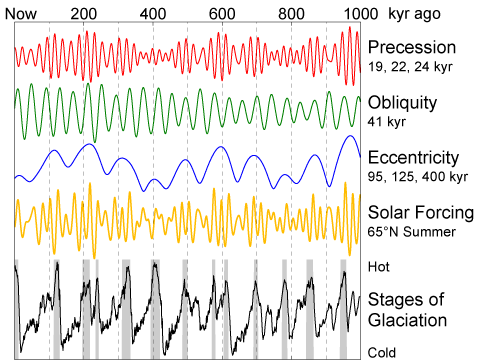
At the heart of this issue is Milankovitch theory, named after the Serbian astrophysicist who developed it in the early 20th century. It holds that the Earth's orbital parameters have cycles of variation which determine not only the amount of solar radiation Earth receives, but also the spatial and temporal distribution of this energy (if you want a refresher, click here and here for an excellent, in-depth primer). Their combined rhythm is what drives many of our planet's climatic trends on a long term basis.
The pacing of the Earth's glaciation cycles by the Milankovitch cycles.
In the image above you can see that the approximately 100 ky cycles of the Quaternary glaciations appear to be paced by eccentricity. However, of the three orbital forcing components, it is 20 ky precessional signal which has the most dominant influence on the state of Sahara. Land surfaces heat up more quickly under summer insolation than the ocean, and the resultant atmospheric pressure difference drives moist marine air over the African continent, where it rises and cools to produce the rainfall that we call a monsoon. Land warming is increased when the perihelion is closest to the boreal summer, and the combined effect of the 9 ka orbital configuration is a ~6% higher monsoon season insolation over northern Africa compared to today. The resultant increase in the land-sea thermal contrast intensifies the West African monsoon, bringing this seasonal precipitation deeper and more northwards into Africa and painting the Sahara green with life — or so goes the theory.
When evidence for the green Sahara was first emerging, atmosphere general circulation models (AGCMs) were used to explore the effect of mid-Holocene orbital forcing on climate in North Africa. Since these models could be run repeatedly with minor changes, they were used to determine the sensitivity of the results to orbital parameters and to changes in boundary conditions (such as sea surface temperatures and the ice sheet configuration), and the experiments were were largely successful in simulating the degree of rainfall intensification suggested by the paleoclimatic evidence. One model's increase in mid-Holocene monsoon wetness in North Africa (approximately 0 – 30 °N) compared to modern can be seen below.
Modelled latitudinally-averaged precipitation – evaporation anomaly (9ka – 0ka). Dashed line shows results of a run which prescribed a North American ice sheet. Reproduced from Kutzbach & Otto-Bliesner (1982)
By the end of the 1980s, it seemed like climate models forced by mid-Holocene conditions were able provide a fairly "realistic" simulation of a green Sahara, reaffirming the theories — developed more than half a century previously — of the control of long term climate by insolation cycles. In the my next post I'll expand on why the initial understanding of the green Sahara described here isn't quite as rosy as it seemed.
52 days? That is indeed a long, long way. Credit: Basil Pao @ www.palintravels.com
Last night I happened to catch my parents enjoying an ageing Python slinking his way across North Africa (a recommended watch), and I was struck by Michael Palin's phrasing:
We're now into what my French guidebook calls desert absolu: absolute desert. The earth stripped clean. As bare as a glacier, as featureless as the sea.
If I asked you to describe what you associate with the word "Sahara", I'd hazard a guess that you'd paint a picture of an incredibly arid environment; maybe endless rocky plains or an expanse of rolling sand dunes only occasionally punctuated by a clutch of palm trees around an oasis. However if I could travel back six thousand years ago to the mid-Holocene and ask the same question to a human living in the region, the response would be very different.
Water is the key to life, and the above photo shows the vivifying effects of the West African monsoon (WAM). I'm using it here to provide an indication of what a typical Saharan landscape may have looked like to somebody living there during what is known as the African Humid Period (AHP, ~11.5 – 5.5 ka). Though it may seem fanciful, the idea that heavy monsoon rains extended deep into northern Africa, sustaining a lush and verdant terrain criss-crossed by a network of lakes, marshes and wetland ecosystems, is supported by many lines of proxy evidence:
This mid-Holocene green Sahara was no one-off freak occurrence, either. On the contrary there were repeated northward shifts in the monsoon position over the Quaternary Period, resulting in alternating phases of humidity and aridity in North Africa as inferred from lucustrine and marine sedimentary records.
It's therefore evident that the image we have of the Sahara is one very specific to how we know it to be today. That may seem like a truism, but I believe it's important to stress that the environment around us can change rapidly on a continent-wide scale, and has dramatically done so in the recent past. In the context of ongoing climate change, the motivation to understand how the Sahara is able to change states so dramatically should be clear. If this interests you as much as it does me, then you'll be delighted to find that this is topic of my next post.
... is not a question I'm going to answer. If you're reading this then chances are very high that you're on my course, so you already well versed in geoengineering. Still, this short video provides a neat introduction to the concept, and was made in partnership with UCL. I encourage you to share it with friends and relatives who might not take such an interest in the environmental sciences, and then hopefully open up a dialogue with them about it.
Hearken; Behold, there went out a sower to sow: And it came to pass, as he sowed, some fell by the way side, and the fowls of the air came and devoured it up. And some fell on stony ground, where it had not much earth; and immediately it sprang up, because it had no depth of earth: But when the sun was up, it was scorched; and because it had no root, it withered away. And some fell among thorns, and the thorns grew up, and choked it, and it yielded no fruit. And other fell on good
ground, and did yield fruit that sprang up and increased; and brought
forth, some thirty, and some sixty, and some an hundred.
In the Synoptic Gospels, a certain wise teacher clarifies to his disciples that the above introduction to his lakeside sermon was no mere lesson in agricultural practice, but an elegant way of illustrating to the gathered crowd the primacy of a believer's state of heart and mind in determining their capacity to prosper from his gospel.
As evidenced by the name of this blog, it is the second scenario described by Jesus which is of particular interest to me. I pray that I have his blessing to co-opt The Parable of the Sower as a far more prosaic analogy: the importance of considering the condition of the Earth in the potential use of large-scale forest plantation as a form of biogeoengineering. The potential of afforestation and related technologies to sequester CO2 from the atmosphere, thereby mitigating climate change is the subject of a growing body of scientific literature. Indeed, the IPCC stresses that these methods " play a major role in many mitigation scenarios" (AR5 Sythesis Report, Box 3.3). It would not therefore be wholly absurd to suggest that the 21st century will see the establishment of many new forests in the fight against climate change.
To innocent eyes, it would seem blindingly obvious that any proposition which involves planting more trees must be A Good Thing. Personally, I'm not so convinced. Of course, like (almost) any university student found wondering in the halls of their Geography department, I desire little more than to see the global community take strong, effective and co-ordinated action to order to avert a catastrophic warming of our home planet. Nevertheless, I feel urged to question whether our current understanding of climate science has yet reached a level of maturity at which humanity can begin to safely engage in the extensive modification of the Earth System.
What is the likelihood that biogeoengineering, effected without due consideration for any issues that may arise - environmental, technological and social - will have grave unintended consequences? If short-sighted economic thinking is allowed to dominate the discourse, it appears to me to be an inevitability. Even the ostensibly low-risk technologies related to afforestation, though appearing fruitful at first, may prove over time to be of little lasting value: much like the seed sown on stony ground.